
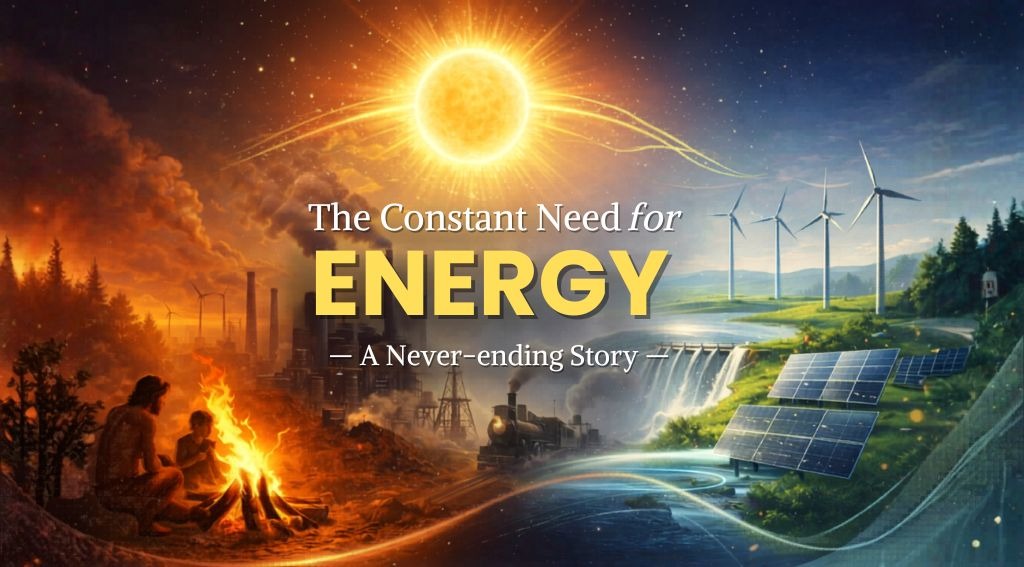

The Constant Need for ENERGY
A Never-ending Story
#Energy is essential for anything and everything. It’s a prerequisite for life.
All energy on the Earth comes from the Sun, our nearest star. Life on Earth would have been unthinkable without the Sun as a natural source, releasing massive amounts of energy every second.
Even with the Sun as a gigantic source of energy, early humans needed another source of energy. They needed a source of light to pierce the thick darkness of night; they needed a source of heat to get warm in brutal winters, to cook food on, to sit round and tell stories; so they made fire.
Humans, seeking energy in the form of light and heat, cut down trees, chopped logs, and fed the fire with dry wood. Their nights were lit by lamps filled with oil obtained from nuts, seeds, or animal fats, and by candles made of wax.
Humans also recognized energy as a weapon against the enemy in the battleground, when they invented black powder, first type of explosive mixture, and used it in large, heavy cannons that fired solid metal or stone balls.
As time went by humans discovered fossil fuels, the fossilized remains of once living things, buried deep inside the Earth. Fossil fuels are plants and animals died hundreds of millions of years ago, even before the dinosaurs, and were converted—by the processes inside the Earth—into coal, crude oil, and natural gas.
Once humans found fossil fuels, the world changed dramatically as these new sources of energy revolutionized the way humans lived. Energy stored in fossils—that could be released by burning these fossils—was used as a source of power that could make machines work and run engines.
Meanwhile, humans understood how to utilize the power of steam, and they began using coal-fired steam engines to drive locomotives.
Crude oil was separated out into various products including petrol, diesel, and LPG. While petrol was used in car engines, buses, trucks, and locomotives too ran on diesel. LPG, a mixture of gases kept in a liquid form by the pressure in a container, was widely used for cooking.
With the advent of electricity came a radical change. Because electricity could be transported long distances and used in countless applications, it was the most versatile source of energy.
Fossil fuels, though a valuable source of energy, are limited; they will run out some day, and they can’t be replenished even in many, many centuries. When coal and oil burn, they pollute the air and release a large excess of carbon dioxide that traps heat, making the Earth warmer than usual.
So humans are now seeking ‘green alternatives’ to fossil fuels. They are now looking for energy sources that naturally renew, or replenish themselves, that will practically never run out; they are looking for sources that provide clean energy.
Humans have identified new ‘green ways’ to produce energy. They are now able to harness the energy in the Sun, wind, Earth’s crust, and moving water. Humans today can even harness the incredible amount of energy released when atoms of Uranium are split.
The world also saw energy in its most destructive form when the US dropped two nuclear bombs on Japan in 1945, killing thousands of people in a matter of seconds.
Despite an enormous growth in renewable energy use, fossil fuels still dominate the global economy. Coal, oil, and gas supply lines continue to be lifelines of economies worldwide.
Again, fossil fuels are not distributed evenly around the Earth.
Countries without coal, oil, or gas reserves depend on those with abundant reserves for their energy needs. These countries depend crucially on energy imports for their survival. They need large quantities of fossil fuels—shipped or piped to them every day—to feed their energy-hungry economies.
The world today is facing an unprecedented crisis.
The ongoing conflict in West Asia has disrupted global energy supplies, pushing up prices and causing fuel shortages across the world.
This war that came as the biggest energy supply shock in recorded history, has led the world to an #EnergyCrisis like never before.
The US-Iran-Israel war has fully exposed gaps in #EnergySecurity which continues to take center stage in world affairs.
The Law of Conservation of energy says that energy is neither created nor destroyed.
When people use energy, it doesn’t disappear, it transforms, it changes into another form.
Energy keeps changing its form, and so does its story.
Energy never dies, and its story never ends!
Shubhra Atreya
Content Writer
IT Department
Subharti University

