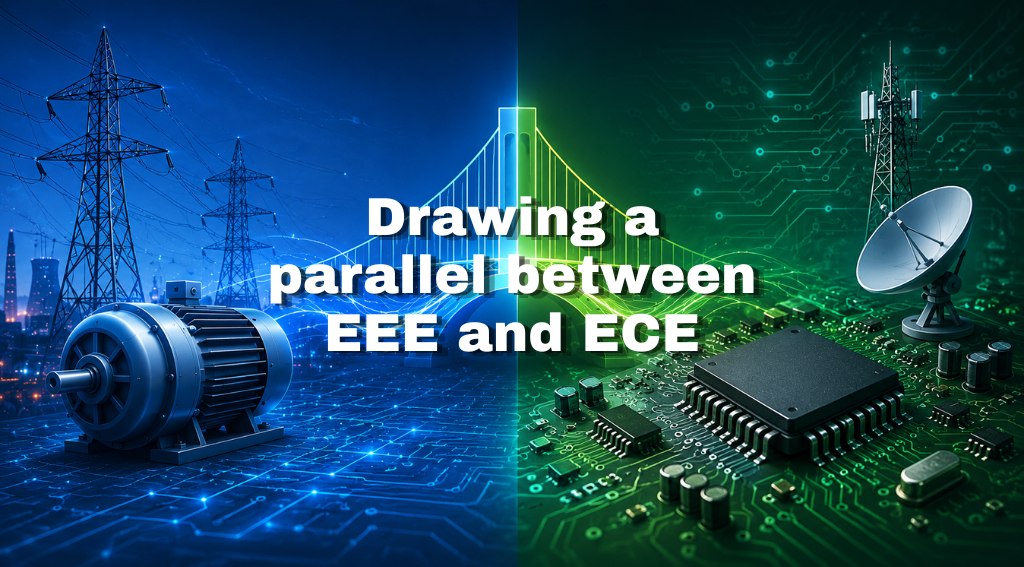

Electrical & Electronics Engineering (EEE) and Electronics & Communication Engineering (ECE) are frequently grouped together because they share a common mathematical and physical foundation—the study of electricity, electromagnetism, and basic circuitry.
However, their primary objectives—and the physical scale at which they operate—are distinctly different. If EEE is fundamentally about the power that runs the world, ECE is about the information that connects it.
The Macro Scale: Electrical & Electronics Engineering (EEE)
EEE focuses primarily on the generation, distribution, storage, and utilization of electrical energy. It is the macro side of the engineering spectrum, dealing with high-voltage systems, heavy machinery, and large-scale infrastructure.
Students in an EEE course spend a significant amount of time studying electrical machines—motors, generators, transformers, power grids, and thermodynamics.
The electronics portion of EEE usually focuses on power electronics—how electronic devices are used to control and convert massive amounts of electrical current efficiently.
Graduates typically pursue careers managing power grids, designing renewable energy systems, working in heavy manufacturing plants, or developing electric vehicle infrastructure.
The Micro Scale: Electronics & Communication Engineering (ECE)
ECE shrinks the focus down to the micro and nano levels. Instead of moving massive amounts of power to run machinery, ECE is concerned with using low-voltage electrical signals to process, transmit, and receive data.
The ECE curriculum dives deep into semiconductor physics, microprocessors, digital logic design, and electromagnetic wave theory. A massive component of ECE is the communication aspect—learning how to encode data, transmit it over complex networks (cellular, satellite, fiber optics), and decode it securely at the destination.
Career paths for ECE graduates lean heavily toward telecommunications, semiconductor design (VLSI), embedded systems, and consumer hardware development.
The Intersection
While their end goals differ, the disciplines overlap heavily in areas like control systems (the logic that keeps automated systems operating safely) and basic programming.
To put it simply—EEE engineers build the electrical infrastructure that powers a massive data center, while ECE engineers design the microscopic transistors inside the servers and the network switches that route the data.
Deciding between the two depends entirely on what kind of problems you want to solve. If you are fascinated by large-scale infrastructure, the transition to sustainable energy, or industrial automation, EEE offers a direct pathway into those fields. If your interests lie in smartphones, the Internet of Things (IoT), 5G networks, or computer hardware, ECE provides the specialized knowledge required to innovate in the area of tech and communications.
Both EEE and ECE are highly foundational courses, but they enable you to shape vastly different parts of the modern world.
Shubhra Atreya
Content Writer
IT Department
Swami Vivekanand Subharti University