
For decades, the professional world has pushed a persistent myth: you are either a creative who belongs in the arts, or an analytical thinker destined for the sciences. Students are often made to choose between the canvas and the calculator.
However, modern animation shatters this false dichotomy, proving that you can build a thriving career at the exact intersection of artistic expression and technical precision.
Pixar’s co-founder John Lasseter says, “The art challenges the technology, and the technology inspires the art.”
Here is how a career in animation offers the ultimate hybrid experience …
Animation is an art
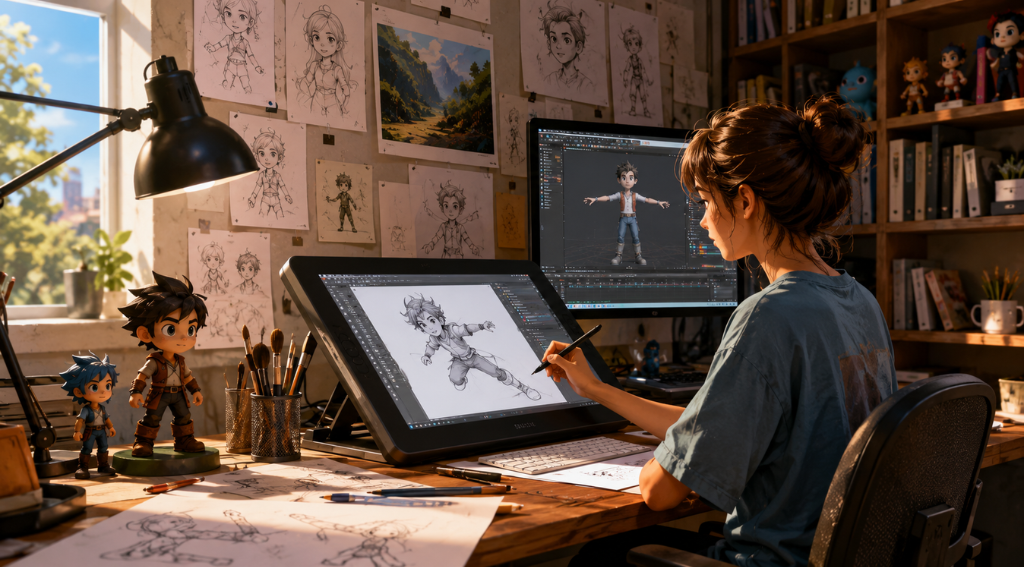
At its core, animation is the art of storytelling. Regardless of the software used, an animator must understand human emotion, color theory, composition, and timing.
Animators are essentially actors with digital puppets; they must observe life closely to know how the subtle twitch of an eyebrow conveys skepticism, or how the slump of a shoulder communicates defeat.
This requires the traditional eye of an artist. Character designers sketch out personalities, concept artists paint breathtaking worlds to establish mood, and storyboard artists frame shots to maximize narrative impact. It is a deeply empathetic and creative process designed to resonate with an audience.
Animation is not possible without science
However, translating that emotional, artistic vision to a cinema screen requires a lot of science. In the realm of 3D animation and visual effects (VFX), you are no longer just drawing a picture; you are simulating reality.
To make a dragon fly convincingly or a dancer leap with believable weight, animators must understand mass, momentum, center of gravity, and inertia. If the physics is wrong, the human eye instantly rejects the animation as fake.
3D models are built from complex mathematical web. Subdivision surfaces, vector math, and Cartesian coordinates are the fundamental building blocks of every digital character you see on screen.
Behind every major animation project is a small army of programmers writing code (often in Python or C++) to build better tools, render millions of individual strands of fur, or simulate the chaotic, unpredictable flow of ocean water.
What you need is a hybrid mind
If you love both art and science, several specific roles in the animation industry demand a hybrid mind —
Character Technical Directors – They build the “digital skeleton” inside a 3D model. This requires deep anatomical knowledge of muscle and bone (art) combined with complex scripting (science) to ensure the character’s skin deforms naturally when it moves.
Lighting Artists – These artists paint with light to set a scene’s emotional tone, much like a cinematographer. Yet, they do so by manipulating digital optics, ray-tracing algorithms, and the physical properties of how light bounces off different materials.
FX Artists – Creating explosions, magic spells, or crumbling buildings means balancing visual spectacle with advanced fluid dynamics and particle physics.
The most exciting innovations happen when disciplines collide.
Animation offers a rare, fulfilling career path where technical problem-solving directly fuels creative expression.
You don’t have to choose between art and science—in this industry, one simply cannot exist without the other.
Shubhra Atreya
Content Writer
IT Department
Swami Vivekanand Subharti University