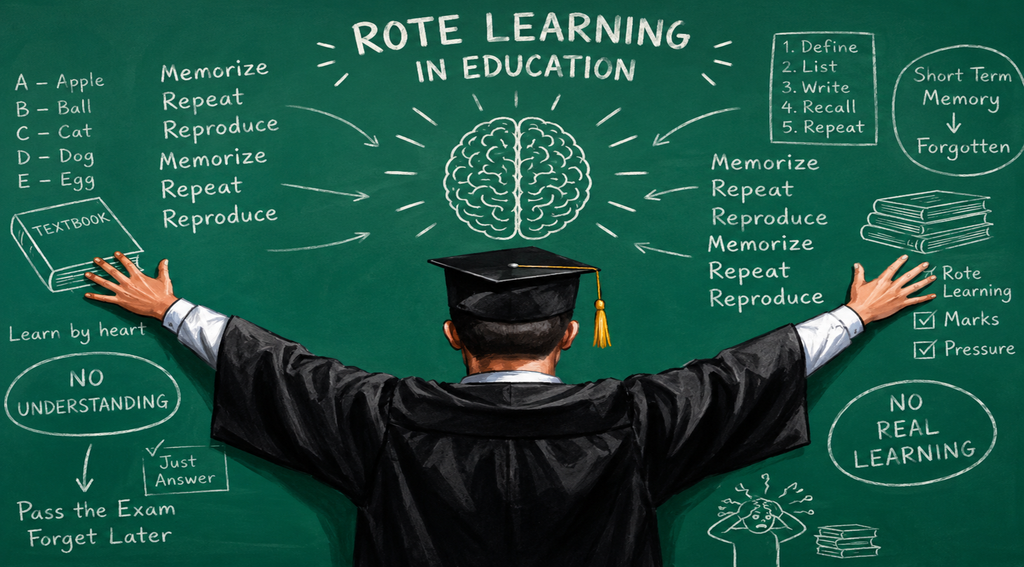

Rote Learning in Education: How far will it go?
Students chanting multiplication tables, historical dates, and scientific definitions in classrooms—this is how they learn; this is the old way of Rote Learning, a process of memorizing information based purely on repetition, a traditional method of keeping facts in mind, which has long been the basis of education in India.
But as we stand in the midst of an unprecedented technological revolution, a critical question emerges—How far will rote learning really go?
In short, it has already reached its peak. Though it once served as a necessary tool in an information-scarce world, it is now rapidly becoming a liability in an information-abundant era.
You need it to some extent, don’t you?
To be fair, rote memorization is not entirely devoid of value. It provides the cognitive scaffolding necessary for higher-level thinking …
>> You must memorize basic vocabulary before you can write poetry or debate philosophy.
>> Knowing multiplication tables by heart frees up mental bandwidth for complex problem-solving.
>> Remembering the basic elements is necessary before exploring complex chemical reactions.
Rote learning teaches a student what to think, but it utterly fails to teach them how to think.
Don’t let it become a habit!
The primary limitation of rote learning is that it creates a rigid, inflexible mind. When students are rewarded solely for memorizing facts, they are inherently discouraged from questioning them. This creates a severe innovation deficit.
In the real world, problems are rarely presented as standardized tests with one objectively correct answer. Modern challenges require critical analysis, creative problem-solving, and adaptability.
A student addicted to rote learning will hit a wall the moment they encounter a scenario not covered in their textbook. They can recite the formula, but they cannot invent a new one.
Rote-learning is not an option, given that it’s an AI-driven world.
Today, any factual question can be answered by AI in milliseconds. If our education system merely trains students to act as biological hard drives, it is training them to compete in a race that machines have already won.
The workforce of tomorrow will not pay for the retention of facts; it will pay for the application of knowledge. The future belongs to the creatives, and the critical thinkers who can leverage information, rather than just store it.
So, how far will rote learning go? As a primary pedagogical tool, it won’t go much further. It will survive only as a brief, introductory phase in early education—a minor stepping stone rather than the entire journey.
If students today want to prepare themselves for the realities of the future, they must pivot decisively away from memorization and towards comprehension, curiosity, and creativity.
Teachers need to stop testing how much students can remember, and start discovering what they can create.
The era of rote learning is ending; it’s an obsolete way of learning, which is now in need of replacement.
Shubhra Atreya
Content Writer
IT Department
Swami Vivekanand Subharti University